 BACK
BACK
The digital era has redefined the business landscape, intensifying the demand for skilled IT professionals who can drive innovation and support sustainable growth. Yet, organisations worldwide are grappling with a severe talent shortage.
According to the Korn Ferry Institute, the tech industry is expected to face a shortfall of 4.3 million skilled professionals by 2030. Traditional hiring models are becoming increasingly costly and rigid, especially as projects grow in complexity and require faster turnaround.
Many companies are turning to outsourcing, not merely to reduce costs, but to unlock greater flexibility and strategic growth. IT outsourcing provides businesses with on-demand access to global talent, enhancing scalability, and providing access to specialised capabilities that might be difficult to source locally. The global IT outsourcing market is projected to reach approximately $651.54 billion in 2025, growing at a compound annual growth rate (CAGR) of 5.48% through to 2030.
This eBook is a practical guide for tech businesses taking their first steps into outsourcing, demonstrating how to build a highperforming tech team that not only meets today’s needs but also supports future growth. From overcoming talent gaps to boosting flexibility, it offers clear, strategic insights to help you navigate outsourcing with confidence in a fast-changing digital world.
Table of contents
Why outsourcing your tech team makes strategic sense
With the rapid advancement of transformative technologies like AI and cloud computing – and the growing importance of cybersecurity – IT has become a critical competitive driver for modern businesses But finding and keeping top tech talent remains a major challenge. This chapter explores why building an outsourced tech team is a strategic move in an increasingly complex and innovation-driven digital landscape.
The evolving landscape of IT talent demands
The IT sector is undergoing a profound transformation, driven by advancements in artificial intelligence (AI), cloud infrastructure, and cybersecurity. These developments require professionals with cutting-edge skills. However, the supply of such talent is significantly limited. A Deloitte survey revealed that nearly 90% of tech leaders identified recruiting and retaining skilled IT professionals as a major challenge, which is causing delays in critical projects.

To make matters more complex, the pace of technological change is accelerating. Many technical skills now become outdated in as little as two to three years, requiring ongoing upskilling that internal teams often struggle to keep up with. This constant evolution leaves organisations at risk of falling behind more agile competitors that can adapt quickly to emerging technologies.
The limitations of local hiring
Australia’s tech workforce reached over one million in 2024, marking a 60% increase since 2014. Despite this growth, demand continues to outstrip supply. To keep pace with digital transformation, the country will need an estimated 1.3 million tech professionals by 2030. This growing gap impacts a wide range of roles, from fullstack and cloud engineers to data analysts, QA/QC testers, and more. As businesses embrace emerging technologies, competition for skilled talent has become more intense than ever.
While traditional hiring remains essential, it often falls short of meeting the pace and flexibility modern organisations require. Building in-house tech teams demands significant investment in recruitment, onboarding, and infrastructure. And once established, these teams can find it difficult to adapt to fluctuating workloads or fast-moving digital initiatives, leading to slower progress, increased pressure, and missed opportunities for innovation when agility is most needed.

Why Vietnam stands out as a tech outsourcing destination
Vietnam has quickly risen as a leading destination for IT outsourcing, thanks to a unique set of advantages that meet the evolving needs of modern businesses.
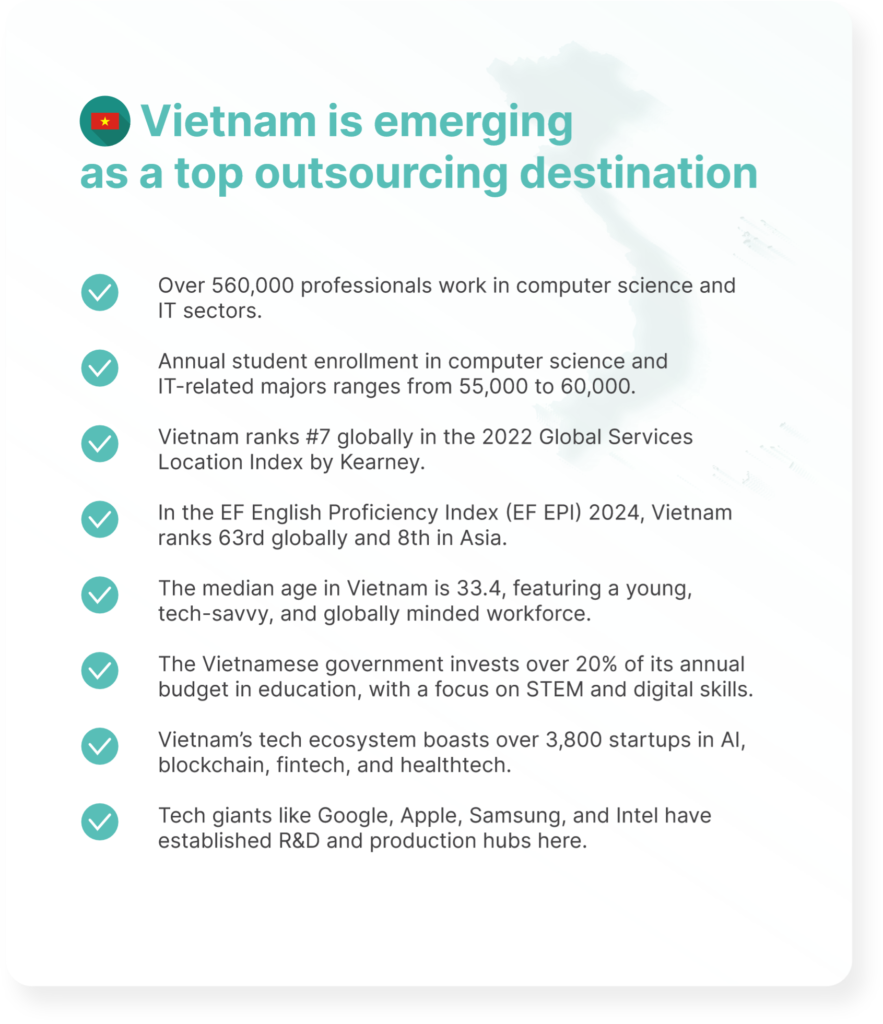
The country’s IT outsourcing sector is expanding rapidly, with the market expected to reach $880 million by 2028. This growth is driven by a young and dynamic workforce, with around 560,000 professionals in computer science and IT-related fields. Supported by government-backed initiatives, Vietnam has developed a robust IT ecosystem, positioning itself as a key player in global software development and digital transformation. Additionally, the country’s cultural compatibility, strong work ethic, and solid English proficiency make collaboration with international companies seamless.

In comparison to traditional outsourcing hubs, Vietnam is well equipped to tackle IT talent shortages. Unlike traditional BPO hubs like the Philippines and India, where rising demand has pushed up wages and turnover, Vietnam offers competitive pricing without sacrificing quality. Its affordable cost of living and stable sociopolitical environment make it an appealing choice for businesses seeking scalable, reliable tech expertise, delivering high-quality solutions without the challenges of oversaturated markets.
The strategic advantages of outsourcing
- Access to a global pool of IT professionals: Outsourcing eliminates geographical barriers, offering businesses access to a vast, skilled talent pool. Whether it’s software developers or QA/QC testers in regions like Southeast Asia, companies can tap into expertise that may be scarce or costly locally.
This global reach fosters innovation, bringing fresh perspectives and specialised skills to projects, ensuring highquality outcomes. With 92% of G2000 companies relying on IT outsourcing, it highlights the effectiveness of this strategy in accessing top-tier talent across the globe.
- Enhanced flexibility to scale teams: Business needs are ever-changing, with project demands shifting based on market dynamics and strategic priorities. Outsourcing offers the flexibility to scale tech teams rapidly without the overhead of costly local hiring or lengthy recruitment processes. This adaptability allows companies to respond quickly to new opportunities or challenges, maintaining agility in a competitive landscape.
- Optimised operational costs without compromising quality: Outsourcing provides significant cost savings compared to hiring locally in high-wage regions like Australia or the US, while still meeting rigorous quality standards. By leveraging economies of scale and tapping into talent-rich regions with budget-friendly costs, businesses can optimise their operational budget. This enables them to redirect resources into innovation and strategic initiatives rather than incurring high overhead costs.
Key IT roles ideal for outsourcing
To fully capitalise on skill-based outsourcing, businesses need to strategically identify roles that deliver both financial and operational benefits. These key positions in IT outsourcing offer vast potential to deliver efficiency and cost-effectiveness:
- Software developer: Offshore developers design and build software solutions tailored to your business goals, enabling more robust, customised applications.
- App developer: Remote app developers create engaging, user-friendly mobile applications that increase customer interaction, brand loyalty, and market presence.
- Back-end developer: These specialists design and maintain secure, scalable server-side systems that are essential for application performance and security.
- Cloud engineer: Cloud engineers ensure smooth management of cloud infrastructure, providing scalability, flexibility, and secure access to resources that support business growth.
- Data analyst:Offshore data analysts help transform raw data into actionable insights that influence strategic decisions and uncover business opportunities.
- Data engineer: These professionals build and maintain robust data pipelines that ensure smooth and continuous data flow, crucial for data integration and analytics.
- DevOps engineer: Remote DevOps professionals streamline development, operations, and deployment processes, facilitating faster, more reliable software releases.
- Front-end developer:These specialists design engaging and responsive user interfaces that enhance the user experience, improving accessibility and interaction with digital platforms.
- Full-stack developer: Full-stack developers handle both front-end and back-end development, offering end-to-end solutions that provide seamless integration across your application.
- QA/QC tester:These professionals rigorously test software to identify bugs, ensure functionality, and maintain high standards of quality before launch.
- System administrator: Offshore system administrators ensure that IT infrastructure is managed effectively, offering support for system maintenance, upgrades, and security.
- Web developer: Web developers design and maintain websites, ensuring optimal functionality, performance, and user experience across all devices.

Finding the right talent for your tech team
Building a successful tech team requires more than filling roles; it demands precision in talent alignment and strategic outsourcing. This chapter explores why a “one-size-fits-all” model often falls short and outlines how custom recruitment and the right outsourcing partnerships can help businesses scale with the right expertise, cultural fit, and long-term impact.
The pitfalls of generic outsourcing models
“One-size-fits-all” outsourcing often falls short in the fast-paced world of IT. These approaches prioritise speed and scale over precision, leading to teams that may lack the specialised technical skills or domain knowledge required for complex projects. Developers unfamiliar with your tech stack, infrastructure, or industry-specific tools can slow progress, introduce errors, and increase time spent on rework. Cultural mismatches also pose real risks, misaligned communication styles, workflows, or expectations can disrupt collaboration and undermine team cohesion.
To mitigate these risks, businesses should invest in a tailored outsourcing strategy, one that matches not just technical requirements but also company culture. With a deliberate, strategic approach to building a team, companies can create high-performing IT teams that don’t just deliver consistent results and long-term value.

The importance of tailored recruitment
Customising the recruitment process is essential for successful tech talent acquisition through outsourcing. A tailored approach ensures that new hires align with your company’s technical needs, project objectives, and organisational culture. By clearly defining the required skill sets and cultural expectations upfront, businesses can identify candidates who are not only technically qualified but also a strong fit for the team.
Tailored recruitment also elevates the candidate experience, showing top talent that your organisation values alignment and long-term success. With the support of an outsourcing partner who understands your goals, a customised hiring process becomes a powerful tool to attract and secure high-calibre professionals for your dedicated offshore team.

Key criteria for selecting outsourced IT professionals
Choosing the right IT professionals is essential to building a high-performing, integrated tech team. Here are key criteria to guide your selection:
- Relevant experience: Prioritise candidates with hands-on experience in the technologies and domains your projects rely on. Proven expertise through past roles, certifications, or case studies helps ensure they can hit the ground running.
- Problem-solving and communication: Beyond technical skills, great IT professionals can solve complex challenges and clearly communicate solutions, both crucial for remote collaboration.
- Adaptability: Look for professionals who can quickly adapt to your team’s processes and tools. Whether it’s integrating with your teams’ communication platforms or project management systems, flexibility ensures seamless collaboration.
- Track record of results: Prior success signals future performance. Seek evidence through project outcomes, testimonials, or metrics like system improvements or reduced downtime.
Choosing the right outsourcing partner
The success of your offshore hiring strategy is contingent on choosing a partner who goes beyond finding the right fit – one who understands your business, communicates openly, and is committed to long-term outcomes. When choosing an outsourcing partner, consider:
- Strategic fit: A strong partner takes time to understand your goals, technical needs, and industry challenges. They don’t just react to requests, they offer proactive solutions like talent pipelining or workforce planning to support your business as it grows.
- Transparent communication: Clear and consistent communication is essential. Look for partners who offer regular updates, share progress reports, and stay closely connected through tools like Microsoft Teams. This visibility helps reduce misalignment and avoid costly delays.
- Shared commitment: The right partner is genuinely invested in your success. They focus on quality, not just speed, conducting rigorous screenings and offering flexible engagement models, such as dedicated teams or staff augmentation, to suit your needs.
When evaluating providers, consider their industry experience, approach to collaboration, and ability to scale with you. The right outsourcing partner won’t just deliver talent, they’ll help drive your business forward.
Case study: How Little Hinges scaled development with a dedicated IT team in Vietnam
Little Hinges is Australia’s largest and fastest-growing virtual inspection platform, on a mission to transform property transactions through better data. As the company scaled rapidly, it faced growing challenges in sourcing and retaining skilled tech talent in the local market. To maintain momentum and build the digital infrastructure that powers smarter property decisions, Little Hinges turned to offshore solutions for a more sustainable and scalable approach to growth.
The challenge
According to CEO Josh Kigan, “Finding and keeping great developers in Australia became one of our biggest roadblocks to growth.” The team realised that to scale effectively, they needed to explore talent beyond domestic borders without compromising on quality or cultural fit.
The solution
To overcome local talent shortages and accelerate development, Little Hinges partnered with Away Digital Teams in Vietnam to build a dedicated offshore IT team. The initial team included two senior developers and one development lead, all deeply embedded into Little Hinges’ daily operations.
Rather than treat outsourcing as a cost-cutting measure, the company embraced Outsourcing 2.0, focusing on strategic team extension and long-term integration. Vietnam’s deep pool of skilled tech professionals offered the perfect opportunity to scale with agility while maintaining alignment with Little Hinges’ tools, workflows, and company culture.
The results
- Accelerated sprint execution and on-time delivery
- High responsiveness and strong alignment with internal teams
- Improved cross-functional collaboration, supported by regular in-person engagement
- Enhanced productivity and communication across time zones
The offshore team now operates as a true extension of Little Hinges, filling critical skill gaps while enabling the business to scale with confidence. With a solid leadership structure in place, the company is well-positioned to grow its Vietnam-based team even further in the next phase of expansion.
How to build a high-performing outsourced tech team
Building a high-performing outsourced tech team takes careful planning, goal alignment, and strong cross-border collaboration. This chapter outlines a proven approach to seamlessly integrate offshore teams and drive measurable results.

Define clear objectives
Success with an outsourced tech team starts with clear, measurable goals aligned to your product roadmap. Define specific targets, for example: cutting time-to-market by 20%, hitting 99.9% uptime, or launching a new app in three months, backed by technical KPIs such as bug rates, test coverage, or deployment frequency.

From day one, ensure your team understands how their work supports your broader strategy. Whether it’s resolving bugs fast to boost customer satisfaction or integrating a new API in six weeks, documenting these objectives in a shared charter keeps everyone aligned. Regular reviews tied to these metrics help track progress and course-correct when needed. Clear goals lay the groundwork for accountability and long-term success.
Integrate offshore teams seamlessly
Treat your offshore team as an extension of your in-house workforce by starting with structured onboarding, clear goals, and dedicated mentors. Maintain alignment through regular check-ins, open communication, and shared workflows. Encourage knowledge sharing and support cultural fit with cross-cultural training.
When offshore teams feel connected and valued, collaboration and performance naturally follow.

Equipped with the right tools
A strong outsourced tech team relies on shared tools for smooth, real-time collaboration. Before onboarding, align with your provider and offshore teams on the tools your in-house staff already uses to ensure compatibility and streamline workflows.
Key tool categories to align include:
- Project management: Tools like Jira, Trello, Asana, or Monday.com provide visibility into tasks, deadlines, and milestones. For example, Jira’s sprint tracking capabilities allow both in-house and offshore teams to monitor progress in real time.
- Communication and collaboration: Platforms such as Slack, Microsoft Teams, or Zoom facilitate instant messaging, video calls, and file sharing. Slack’s integration with GitHub, for instance, can notify teams of code commits, enhancing transparency.
- Development and monitoring: Offshore teams will also adapt to the tools your internal team uses, whether it’s IDEs like VS Code, testing frameworks such as Selenium, or monitoring platforms like SonarQube. This alignment ensures consistency in workflows, code quality, and performance standards.
- Build a results-driven workflow To scale efficiently, your outsourced tech team must align with your internal development frameworks through a structured, outcomefocused workflow. Standardised methodologies like Agile or Scrum to promote consistency and a cohesive engineering culture across teams. Regular feedback loops, such as KPI dashboards, help monitor progress and ensure alignment, while data-driven metrics provide objective performance insights.
Build a results-driven workflow
To scale efficiently, your outsourced tech team must align with your internal development frameworks through a structured, outcomefocused workflow. Standardised methodologies like Agile or Scrum to promote consistency and a cohesive engineering culture across teams. Regular feedback loops, such as KPI dashboards, help monitor progress and ensure alignment, while data-driven metrics provide objective performance insights.

By fully integrating offshore teams into this workflow, you create a scalable, high-performing delivery model.
Managing and scaling your outsourced tech team
Outsourcing offers agility, cost savings, and access to global talent, but success relies on effective management and smart scaling. With strong onboarding, clear performance tracking, and strategic alignment, your offshore IT team can seamlessly integrate and drive innovation at scale.

Streamlined onboarding for rapid integration
Effective onboarding is key to getting your outsourced tech team up to speed quickly. A structured program should cover your systems, tools, workflows, coding standards, and security protocols. Provide clear documentation, including tech stack overviews and process guides, and ensure security training is in place to meet compliance and data protection standards.
Pair offshore developers with in-house mentors to support collaboration and address questions early. With the right onboarding, your team can integrate fast, reduce ramp-up time, and start contributing from day one.
Proactive performance management for consistent delivery
Use sprint reviews – regular meetings held at the end of short work cycles (typically biweekly), along with one-on-ones and performance analytics to monitor productivity and address roadblocks early. These conversations build trust and ensure team members feel valued, boosting morale and retention.
Leverage project management tools like Trello or Monday.com to monitor key metrics such as task completion rates, bug frequency, and code review turnaround times. These data-driven insights enable timely, constructive feedback and help identify areas for improvement. Encourage open, real-time communication through platforms like Slack or Microsoft Teams to maintain transparency and quickly resolve issues. By fostering a culture of accountability and continuous feedback, you ensure your team remains productive, engaged, and consistently delivers quality results.

Strategic scaling to match business needs
Scaling an outsourced tech team is about aligning capacity with evolving technical and business demands, not just adding more people. Monitor key metrics like project velocity, workload, and release cycles to identify when scaling is needed.
A reliable outsourcing partner should offer flexible resourcing, quickly bringing in the right talent: developers, QA engineers, or specialists, without disrupting delivery. At the same time, ensure cultural and technical alignment by using structured assessments and clearly defining roles and expectations. This keeps your team cohesive, productive, and ready to meet business goals while maintaining engineering standards. Strategic scaling enables your tech team to stay agile and deliver value at every stage of growth.

Embedding outsourced teams into your culture
To maximise the impact of your outsourced tech team and make them feel like a true extension of your organisation, embed your offshore talent into your mission, values, and engineering culture. This fosters ownership, strengthens collaboration, and ensures alignment with long-term goals.
Include them in key communications like roadmap discussions, sprint reviews, and company updates. Promote collaboration through joint stand-ups and highlight contributions that reflect your core values. When offshore teams understand how their work supports business outcomes, they stay engaged, motivated, and aligned.

Addressing common concerns and overcoming challenges
Outsourcing tech teams unlock global talent, reduces costs, and accelerates innovation, while requiring careful management to ensure success. This chapter explores practical solutions and strategies to build a resilient, high-performing team by fostering alignment, maintaining quality, and turning risks into opportunities for growth.

Build a clear quality framework

To maintain consistent output, start with a strong quality assurance process. Use regular code reviews, automated testing, and clearly documented requirements to align expectations. Set performance benchmarks early and monitor progress with tools like Jira or GitHub to ensure teams stay on track.
Hold biweekly sprint reviews to evaluate deliverables and share actionable feedback. Encourage offshore developers to speak up about challenges or suggest improvements. When teams feel empowered and expectations are transparent, quality becomes a shared commitment, not just a checklist.
Maintain visibility without micromanaging

Outsourcing doesn’t mean losing control, it’s about balancing visibility with trust. Use tools like Jira or Trello to track progress in real time, and schedule regular stand-ups or sprint reviews to stay aligned without hovering.
Focus on outcomes, not every step. When teams consistently deliver quality code on time, give them the autonomy to do it their way. Clear metrics and open communication keep projects on track while empowering your developers to own their work.
Protecting sensitive data

Data security is critical when working with outsourced teams. To protect sensitive information, start with a strong foundation, set clear expectations through non-disclosure agreements (NDAs) or service-level agreements (SLAs), and internal handling policies. Use secure channels for communication and file sharing, and implement access controls like VPNs and multi-factor authentication from the start.
Train your offshore team on cybersecurity best practices, from secure coding to responsible data use. Regular audits and reviews help you stay proactive. When security is a shared responsibility, you can scale with confidence without compromising your data or IP.
Build financial clarity from the start
While outsourcing brings cost advantages, hidden expenses like unclear pricing or extra service fees, can erode your budget. Work with providers who offer transparent, itemised pricing and clearly outline potential add-ons such as training or software licenses. Define detailed scopes and negotiate SLAs that specify deliverables, timelines, and costs. Regular financial reviews help catch discrepancies early and keep your outsourced IT projects efficient and on track.
Retaining top talent for long-term success
High turnover in IT teams, averaging around 18.3%, can disrupt projects and increase costs. To build a stable, high-performing team, prioritise recognition, growth, and communication. Celebrate milestones like feature launches with public shoutouts or awards. Support professional development by providing access to training and certifications. Regular one-on-one meetings help address concerns and align career goals. Fostering engagement and growth keeps your outsourced team motivated, committed, and focused on delivering long-term value.
Embracing the future of outsourced tech teams
As digital transformation accelerates, building a skilled outsourced tech team is vital for maintaining a competitive edge. Outsourcing provides access to global expertise and flexible resources that scale with your evolving needs. Vietnam is emerging as a leading tech outsourcing hub because it offers a rich pool of talented professionals and a supportive environment that drives quality and innovation. Beyond cost savings, success depends on aligning partners with your business goals and culture to ensure seamless integration and clear communication. This fosters a collaborative environment where offshore teams deliver high-quality results and accelerate project timelines.
Long-term success depends on managing outsourced teams that can adapt quickly and innovate continuously. Partnering with the right provider, like Away Digital Teams, grants access to vetted Vietnam-based experts aligned with your objectives. Streamlined onboarding, proactive oversight, and strategic scaling ensure both quality and agility.
Build your ideal tech team with Away Digital Teams to fuel innovation, agility, and lasting impact. Let’s start your transformation journey with confidence today.